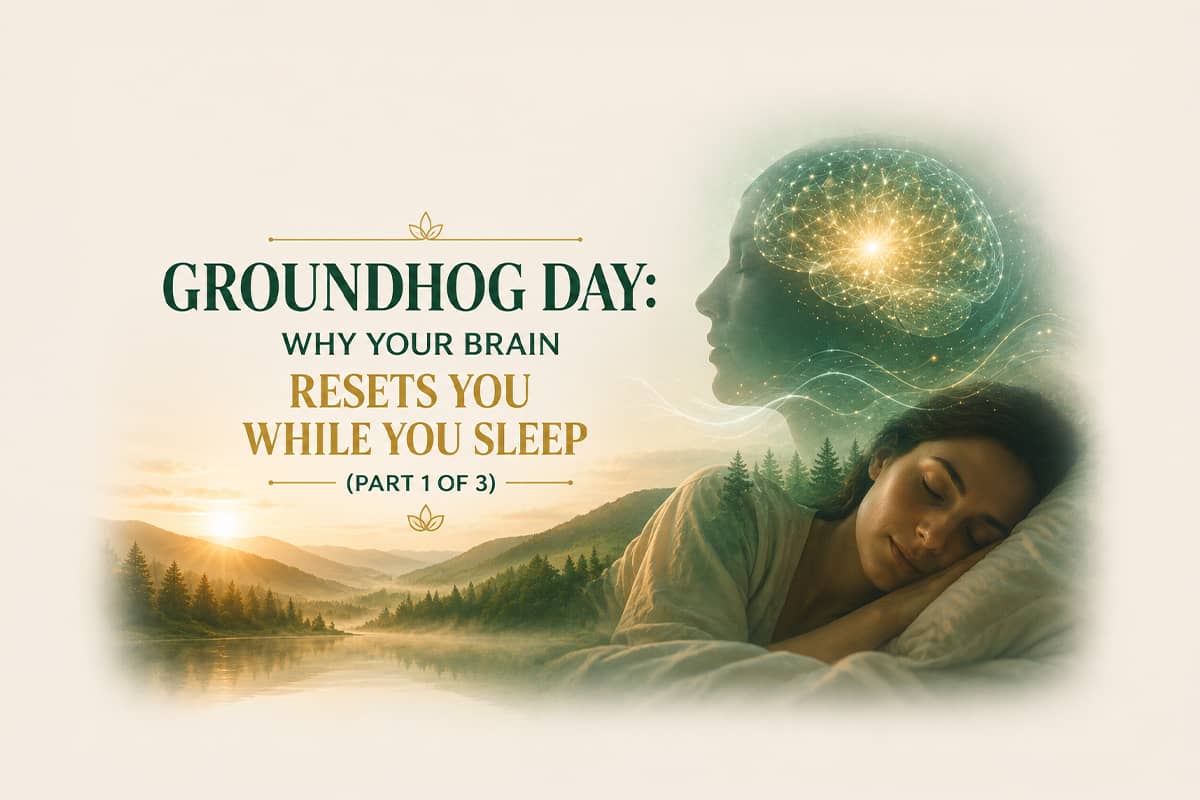
Groundhog Day: Why Your Brain Resets You While You Sleep (Part 1 of 3)
You had an incredible day. Your energy was high. Your thinking was clear. You felt like a different version of yourself, lighter, more focused, more aligned with who you are becoming. You went to bed with positive thoughts. No phone. No late night scrolling. Just quiet intention.
And then you woke up.
The funk was back. The heaviness had returned. Whatever you felt the day before seemed like a distant memory, maybe even a fluke. And somewhere in the back of your mind, a quiet voice whispered: maybe this is just who I am.
I lived this. For a long time I called it my Groundhog Day. The same emotional reset, morning after morning, no matter how good the previous day had been. It was not until I started studying the neuroscience of the subconscious mind and how deeply subconscious programming shapes our daily experience that I understood what was actually happening. And it was not a character flaw. It was biology.
The Brain's First Priority Is Not Your Growth
Before we talk about sleep, we need to understand what the brain is actually optimized for. It is not optimized for happiness, success, or personal transformation. Its first and most fundamental job is survival. And to a significant degree, survival means sameness, aka the known.
This principle is called homeostasis, and it governs virtually every self-regulating system in the body. Neuroscientist Antonio Damasio argues that homeostasis is the core condition underlying all of life, including consciousness itself. The brain is constantly working to maintain equilibrium, a known and familiar internal state that it has learned to associate with safety.
When you have a breakthrough day, when you feel expansive and different and alive in a new way, your nervous system does not register that as progress. It registers it as deviation. And deviation triggers a nervous system reset back to the familiar baseline. This is not a malfunction. It is the system working exactly as designed.
Research published in Graybiel (2008) in the Annual Review of Neuroscience confirms that habits emerge as a result of experience-dependent plasticity in basal ganglia-based circuits that influence not only overt behaviors but also cognitive activity below the level of conscious awareness. The brain does not treat new behavior and old behavior equally. It defaults to whichever pattern has been most practiced, because practiced patterns require less metabolic energy to run.
The Basal Ganglia: Where Your Habits Actually Live
Deep in the primitive brain lives a cluster of nerve cell bodies called the basal ganglia. This is where your habits live, not as thoughts, but as automatic programs that run below conscious awareness. The basal ganglia do not require you to think. They simply execute.
When you learned to drive, you had to think about every movement. Now you drive while holding a conversation. That shift from effortful to automatic is the basal ganglia doing exactly what they were designed to do. The same process applies to your emotional patterns, your beliefs about yourself, your default relationship with fear, with worthiness, with what is possible for you.
Research on self-directed neuroplasticity published in ScienceDirect in 2024 confirms that pre-existing beliefs and habits residing in the subconscious exert powerful influence over emotional responses and decision-making, often in ways we are completely unaware of. The subconscious mind begins developing in early childhood, meaning some of these programs have been running for decades.
One conscious good day does not yet have the neural weight to compete with thirty years of grooved wiring. The basal ganglia will win. At least in the short term. This is also why so many people ask themselves why they cannot change their habits even when they genuinely want to. The answer is not lack of motivation. It is that the change is being attempted at the conscious level while the habit lives somewhere the conscious mind cannot easily reach.
What Your Brain Actually Does While You Sleep
Here is where it gets both fascinating and, once you understand it, deeply clarifying.
Sleep is not rest in the passive sense. It is one of the most neurologically active states your brain enters. And one of its primary functions during that time is memory consolidation, the process of taking what happened during the day and deciding what to keep, what to strengthen, and what to integrate into your long-term neural architecture.
A landmark review published in Nature Neuroscience by Klinzing, Niethard, and Born (2019) describes this in detail. During slow-wave sleep, the hippocampus replays neuronal firing patterns from the day. These replays are then transferred and integrated into neocortical networks, where they become part of your long-term memory and behavioral architecture. The brain is not passively storing. It is actively rehearsing and reinforcing.
In 2022, Harvard researchers published findings in The Journal of Neuroscience showing the most direct evidence of motor cortex replay ever recorded in sleeping humans. Neural patterns from the waking day repeated themselves during slow-wave sleep, the unconscious brain practicing what it had experienced, reinforcing the pathways most deeply grooved.
And here is the part that changes everything: the brain consolidates what is most dominant, not what is most recent. One powerful day of feeling different is recent. The emotional pattern you have been running for twenty years is dominant. When the subconscious takes the wheel during sleep, it reinforces the architecture with the most repetition behind it.
You wake up reset not because you failed. You wake up reset because your brain successfully completed its maintenance cycle.
REM Sleep and the Emotional Reset
It goes even deeper. Both major stages of sleep play a role in shaping what stays with you. Slow-wave sleep is when the hippocampus replays the day's experiences and hands them off to be woven into long-term storage, while REM sleep has been linked to the processing of emotional memory. Research summarized in Klinzing, Niethard, and Born (2019) in Nature Neuroscience describes how repeated neuronal replay of representations originating from the hippocampus during slow-wave sleep gradually transforms and integrates those representations into neocortical networks, building long-term memory. This is part of why the emotional tone you wake up with is not random. It is shaped by a process that ran all night, reinforcing the patterns your brain has practiced most.
This means the emotional tone you wake up with, the low-grade heaviness, the vague sense of being behind, the return of familiar anxiety, is not random. If you have ever woken up in a bad mood after a genuinely good day and had no idea why, this is the answer. It is the output of a process that ran all night, pulling your most ingrained emotional programs back to the foreground.
The subconscious does not sleep. It works. And while your conscious mind rests, it runs the program it knows best.
The good news embedded in this same research is that sleep also has the power to work in your favor. When you are actively building new patterns through consistent daily practice, sleep consolidates those too. The brain does not discriminate. It strengthens what is most repeated. Which means the goal of transformation is repetition until the new pattern becomes the dominant one.
You Are Not Stuck. You Are Running a Program.
If the Groundhog Day cycle sounds familiar, I want you to sit with something for a moment. The reset is not evidence that you cannot change. It is not proof that you are broken or that yesterday was a fluke. It is simply your nervous system doing its job, protecting you by keeping you in the known.
Everything your body needs to find its way back to balance is already inside you. The capacity for change is already there. What the Groundhog Day cycle is really telling you is not that change is impossible. It is that the subconscious has not yet received enough new information to update the program. This is also why positive thinking alone rarely creates lasting change. Thinking happens at the conscious level. The program runs somewhere deeper.
That is a very different problem. And it has a very different solution.
In Part 2 we go into exactly what works on the subconscious level, why physical movement and a specific kind of meditation practice can begin to rewrite the cycle from the inside, and what the science says about how long it actually takes for a new pattern to become dominant.
At Q-Vibe Wellness, this is the work we are built around. Not because you need fixing. But because sometimes understanding why your body does what it does is the first step toward giving it something new to work with. If this resonated, follow along for Part 2. And if you want to explore where you are right now, take a look at our Quantum Infused Tools and Remote Sessions.
And remember... Self Love is the Best Medicine.
References
Klinzing, J.G., Niethard, N., & Born, J. (2019). Mechanisms of systems memory consolidation during sleep. Nature Neuroscience, 22, 1598-1610. https://www.nature.com/articles/s41593-019-0467-3
Rubin, D.B. et al. (2022). Learned motor patterns are replayed in human motor cortex during sleep. Journal of Neuroscience, 42(25), 5007-5020. https://pmc.ncbi.nlm.nih.gov/articles/PMC9233445/
Graybiel, A.M. (2008). Habits, rituals, and the evaluative brain. Annual Review of Neuroscience, 31, 359-387. https://pubmed.ncbi.nlm.nih.gov/18558860/
ScienceDirect (2024). Awareness Integration Theory: A path to self-directed neuroplasticity. https://www.sciencedirect.com/science/article/pii/S2772632024000229
Klinzing, J.G., Niethard, N., & Born, J. (2019). Mechanisms of systems memory consolidation during sleep. Nature Neuroscience, 22, 1598-1610. https://www.nature.com/articles/s41593-019-0467-3