
One Program Runs All Your Inherited Trauma. What If You Could Delete It?
Your brain runs programs you never chose. Neuroscience has documented this for decades. But what if the brain is not the only operating system running code? What if reality itself follows programs, and one of the most overlooked is the program of hierarchy?
A quick note before we begin. The first part of this article is heavy on neuroscience and physics. If that is not your thing, we understand. But we ask you to stay with it. Every claim we make later in this piece depends on the science landing first. We are not asking you to take our word for anything. We are showing you the peer-reviewed evidence, building the foundation, and then proposing something on top of it that we believe could change the way you think about inherited trauma, family, and identity. The science is the ground. What follows is the view from the top of it.
The Programs You Never Installed
Right now, your brain is running software you did not write and did not approve.
This is not a metaphor. Dr. Ann Graybiel at MIT has spent decades mapping how the basal ganglia, a deep brain structure, converts deliberate actions into automatic routines that run without conscious supervision. Her landmark review in the Annual Review of Neuroscience (2008) defines habits as behaviors that are "performed almost automatically, virtually non-consciously, allowing attention to be focused elsewhere." And the scope goes beyond physical actions. Graybiel documents that habits include "cognitive expressions of routine (habits of thought)" as well as motor expressions.
Read that again. Your brain does not just automate what your hands do. It automates what your mind thinks.
In 2021, a study published in Nature Communications by Smith et al. revealed the specific neurons responsible. D1 receptor-expressing neurons in the dorsolateral striatum encode newly learned actions. D2 neurons promote the expression of habitual, automatic behaviors. One set installs the program. The other keeps it running on autopilot, below your awareness, until something disrupts the loop.
What disrupts it? Awareness.
Research on metacognition, the brain's ability to observe its own processes, shows that the prefrontal cortex acts as the override switch. A study by Fleming et al. (2010), published in Science, found that individual differences in metacognitive ability correlate directly with gray matter volume in the anterior prefrontal cortex. When you become aware of a pattern, the prefrontal cortex engages and the automated loop can be interrupted. A 2026 review in Frontiers in Psychology confirmed this with causal evidence: when researchers disrupted the prefrontal cortex using transcranial magnetic stimulation, metacognitive accuracy dropped while the automatic task performance continued untouched.
The science is clear. If you are not aware of a program, it runs you. The moment you see it, you gain the power to change it.
The brain does not just automate your actions. It automates your thoughts, your emotional responses, and your beliefs. And it will keep running those programs for your entire life unless you become aware that they exist.
But What If the Brain Is Not the Only System Running Code?
Look at nature. Not casually. Look at it the way a programmer looks at source code.
The Fibonacci sequence (1, 1, 2, 3, 5, 8, 13, 21, 34...) appears in the spiral arrangement of sunflower seeds, the branching of trees, the shell of a nautilus, the structure of hurricanes, and the arms of galaxies. A 2022 paper in the peer-reviewed journal Biophysica documented Fibonacci patterns across phyllotaxis (leaf arrangement), seed packing, branching structures, and shell spirals. These are not coincidences. They are the output of what the researchers describe as "informationally effective mathematical regularities." A separate study in The Fibonacci Quarterly demonstrated that asymmetric cell division in biological tissues produces Fibonacci number sequences depending on cell maturation time.
Nature follows code. Not metaphorically. Mathematically.
The Fibonacci sequence in nature: the same mathematical pattern, from cellular division to galactic spirals.
The physical universe is not random. It runs on patterns. Repeating, predictable, measurable patterns. Spirals, cycles, ratios. The same mathematical structure appears at scales ranging from cellular division to galactic formation.
If you are willing to see the brain as a system that runs unconscious programs (and the neuroscience confirms it), then ask the larger question: what if reality itself runs programs? And what if some of those programs, like the ones in your brain, affect you precisely because you do not know they are running?
When Physicists Looked Deeper, the Rules Broke
In the early 20th century, Max Planck and Albert Einstein did something that changed our understanding of reality forever. They looked at the smallest level of matter, the subatomic world, and discovered that it does not follow the rules we assumed.
At the quantum scale, particles behave as waves until they are measured. The double-slit experiment, one of the most replicated results in the history of physics, demonstrates this: when particles pass through two slits without measurement, they produce an interference pattern consistent with wave behavior. When a detector measures which slit the particle passes through, the interference pattern disappears and the particle behaves like a discrete object. The act of observation changes the behavior of matter.
This is the observer effect. It is documented, repeatable, and not in dispute at the quantum scale.
The conventional position is that this effect does not scale to the macro world, to the reality you and I experience. Dr. Joe Dispenza tells a story about physicists who dismissed the idea that the observer effect could apply at larger scales. His response:
"Maybe we are just poor observers."
That line is not a scientific claim. It is a question. And it is exactly the right question. Because every time physicists assumed they understood the rules of reality and then looked more closely, the rules changed. Planck found that energy comes in discrete packets (quanta), not in a continuous stream. Einstein found that time itself is relative. The quantum world revealed that observation alters behavior. At every deeper level of investigation, the operating assumptions of the previous level fell apart.
What if the same is true of the programs running our lived experience? Not the brain's programs. The programs of the matrix itself.
And here is the fact that makes this question impossible to dismiss. In 1911, Ernest Rutherford fired alpha particles at gold foil in one of the most important experiments in the history of physics. The vast majority of particles passed straight through. Only about 1 in 8,000 deflected significantly. His conclusion, now taught in every physics classroom on the planet: atoms are 99.9999999% empty space. The dense atomic nucleus, which contains nearly all of an atom's mass, occupies only 1 part in 10¹⁵ of the atom's total volume. If you scaled an atom up to the size of a football stadium, the nucleus would be the size of a pea at the center. Everything else is energy fields, electromagnetic forces, and quantum probability.
And even that tiny nucleus is not "solid" in the way we imagine. Einstein's 1905 paper in Annalen der Physik, "Does the Inertia of a Body Depend Upon Its Energy Content?", established what we now call mass-energy equivalence: E=mc². Mass is not a separate thing from energy. It is energy in condensed form. As Einstein himself wrote: "The mass of an object is a measure of its energy content."
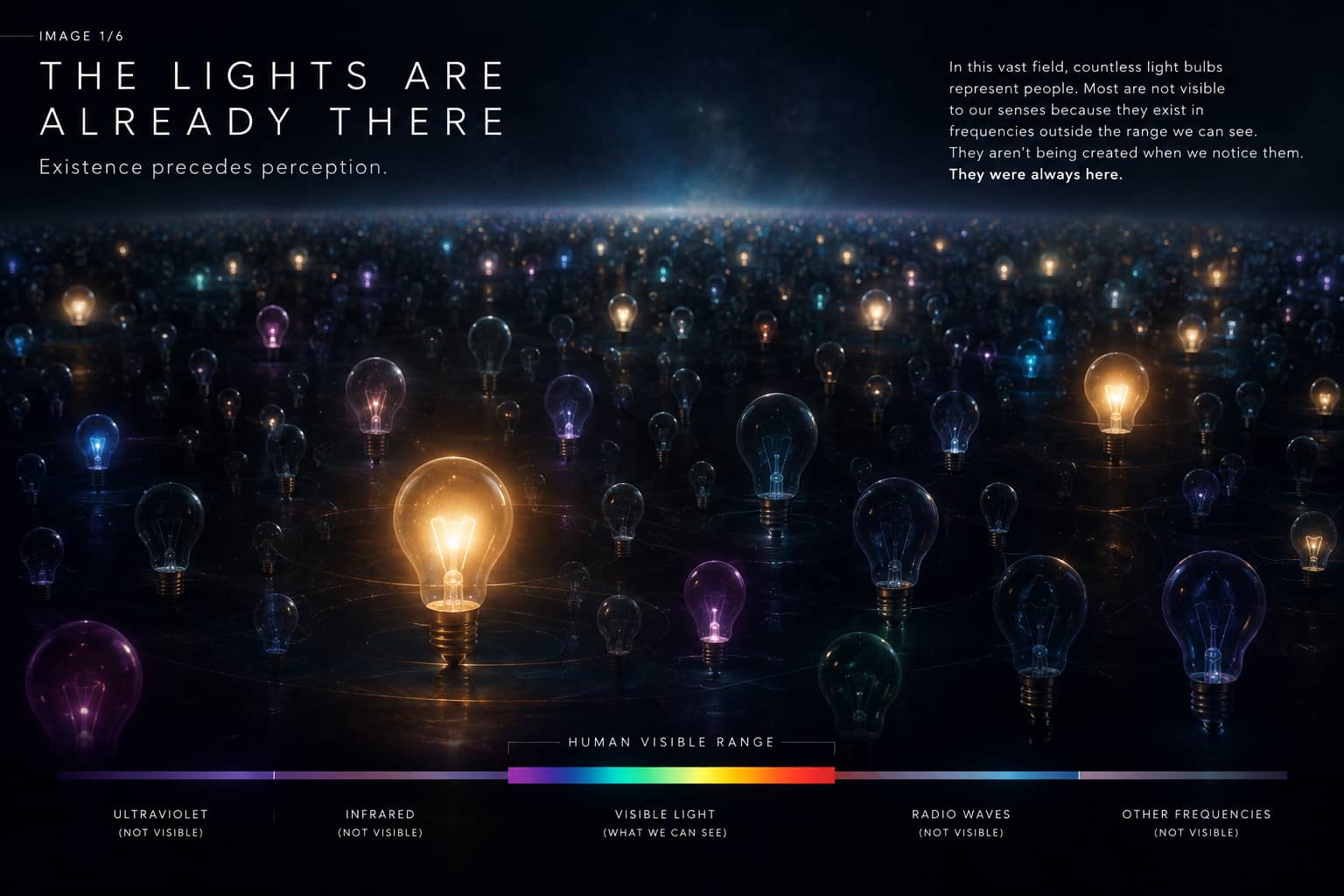
Put those two facts together. Everything is made of atoms. Atoms are 99.9999999% energy. And the remaining 0.0000001% that appears solid is itself energy in a condensed state. The physical world you perceive through your five senses represents a fraction so small it rounds to zero. Everything else, the overwhelming majority of what exists in and around you right now, is energy. Invisible. Immeasurable by your senses. But real.
As Dr. Joe Dispenza puts it: "There is more information in the immaterial than the material." That is not mysticism. It is what Rutherford demonstrated in 1911 and Einstein formalized in 1905. All energy carries information. And 99.9999999% of what you are made of is energy you have never seen.
A Note on What Follows
Everything above is grounded in peer-reviewed science. The neuroscience of unconscious programming, the mathematics of Fibonacci patterns in nature, the observer effect in quantum mechanics, and the atomic structure of matter are documented and verifiable.
What follows is a theory. It is informed by the science above, by observable patterns, and by direct meditative experience. We are not claiming proof. We are proposing a lens. We believe the most honest approach is to show you where the established science ends and the interpretive framework begins, and let you decide what resonates.
The Matrix Runs More Programs Than You Think
If reality runs on programs, hierarchy is not the only one.
Consider the systems that have organized human experience for thousands of years. Astrology assigns personality traits, life paths, and compatibility based on the position of celestial bodies at the time of your birth. Numerology maps behavioral patterns and life cycles to the numbers encoded in your name and birthdate. Seasonal cycles, lunar cycles, planetary transits. These are not random cultural inventions. They are pattern-based systems that describe how energy moves through time, and they affect people whether or not those people believe in them.
From the lens of this theory, these are programs of the matrix. They are the code that organizes experience at scales larger than any individual brain. And they operate the same way unconscious brain programs do: they run you until you become aware that they are running.
Astrology affects you not because the stars control your fate, but because the program is active and unexamined. Numerology influences your patterns not because numbers are magic, but because the matrix uses mathematical structure (as the Fibonacci research confirms) to organize reality. These programs carry information. They shape experience. And most people never question them because they never realize they are operating inside one.
In this article, we are going to focus on one program in particular: hierarchy. We chose it because it may be the most consequential. It is the program that determines who holds authority, how trauma transmits between generations, and why most people never question the power structures they were born into. But understand: hierarchy is one example. Once you see how a single matrix program works, you begin to see all of them.
All Time Is Now
To understand why hierarchy is a program and not a truth, you need to consider a premise that Einstein himself supported.
On March 21, 1955, just weeks before his own death, Einstein wrote a letter of condolence to the family of his lifelong friend Michele Besso. The letter is documented in the Einstein Archives (7-245) and authenticated in multiple scholarly works, including Walter Isaacson's Einstein: His Life and Universe (2008) and Alice Calaprice's The Ultimate Quotable Einstein (2010). Einstein wrote:
"Now he has departed from this strange world a little ahead of me. That signifies nothing. For us believing physicists, the distinction between past, present and future is only a stubbornly persistent illusion."
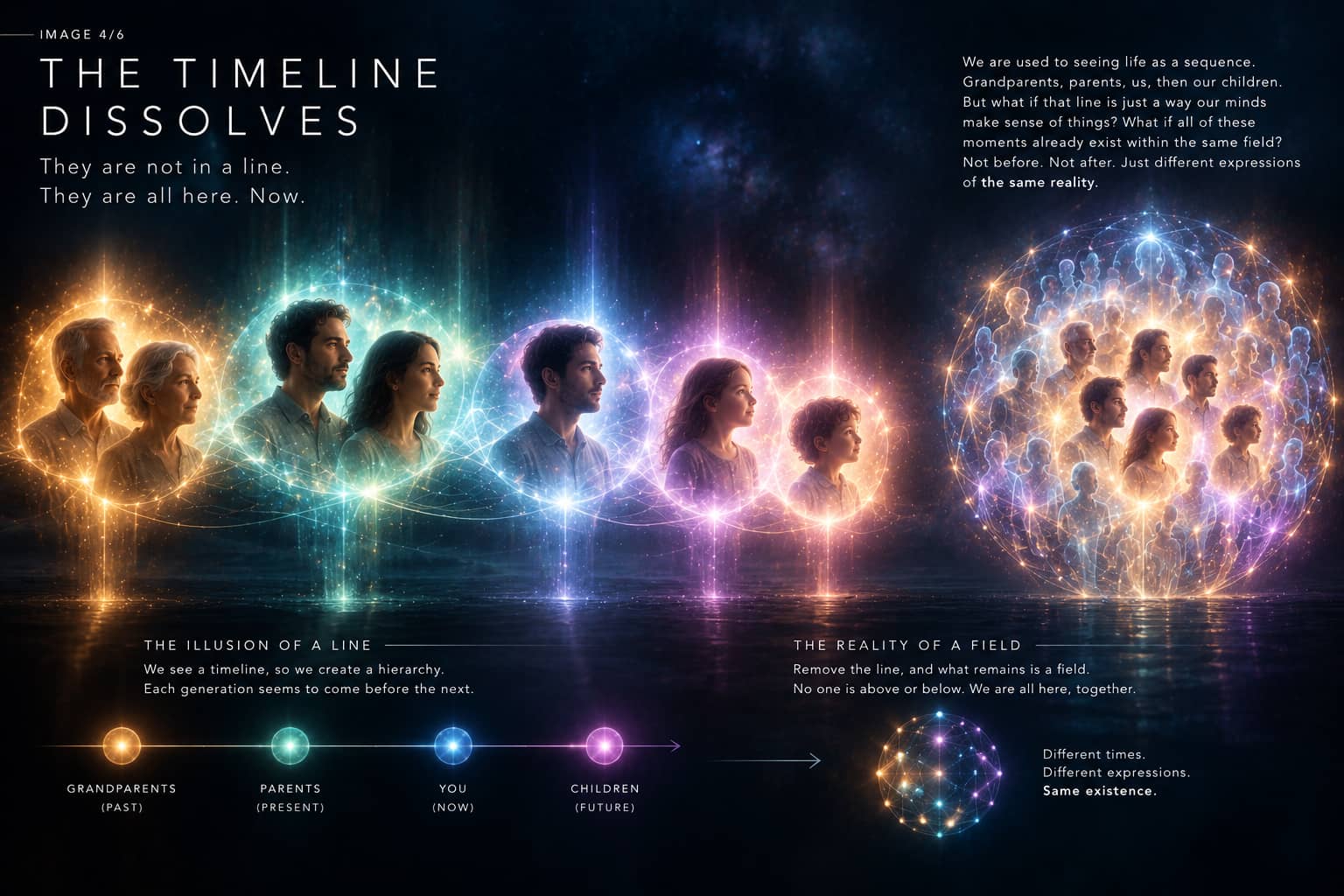
This was a personal letter, not a physics paper. But the idea it expresses is formalized in what physicists call the block universe theory, a mainstream interpretation of Einstein's own special and general relativity. In the block universe model, spacetime is a four-dimensional structure in which all events, past, present, and future, exist simultaneously. There is no privileged "now." The flow of time is a subjective experience, not a feature of reality itself.
This is documented in peer-reviewed physics literature, including George Ellis's work on spacetime at the University of Cape Town (arXiv: gr-qc/0605049) and the Crystallizing Block Universe model (Ellis and Rothman, 2010). The block universe is not fringe. It is one of the most widely discussed interpretations of relativity in theoretical physics. It is also not the only interpretation. Growing block theory and fragmentalism offer competing models. We are presenting it as a valid, mainstream framework, not as settled fact.
But here is what it means if the block universe is accurate: there is no "before" and no "after." All points in time exist. The sequence of events that we experience as past, present, and future is a perceptual framework, not an objective structure of reality.
And if there is no sequence, hierarchy has no foundation.
Hierarchy Requires Sequence. What If Sequence Is the Illusion?
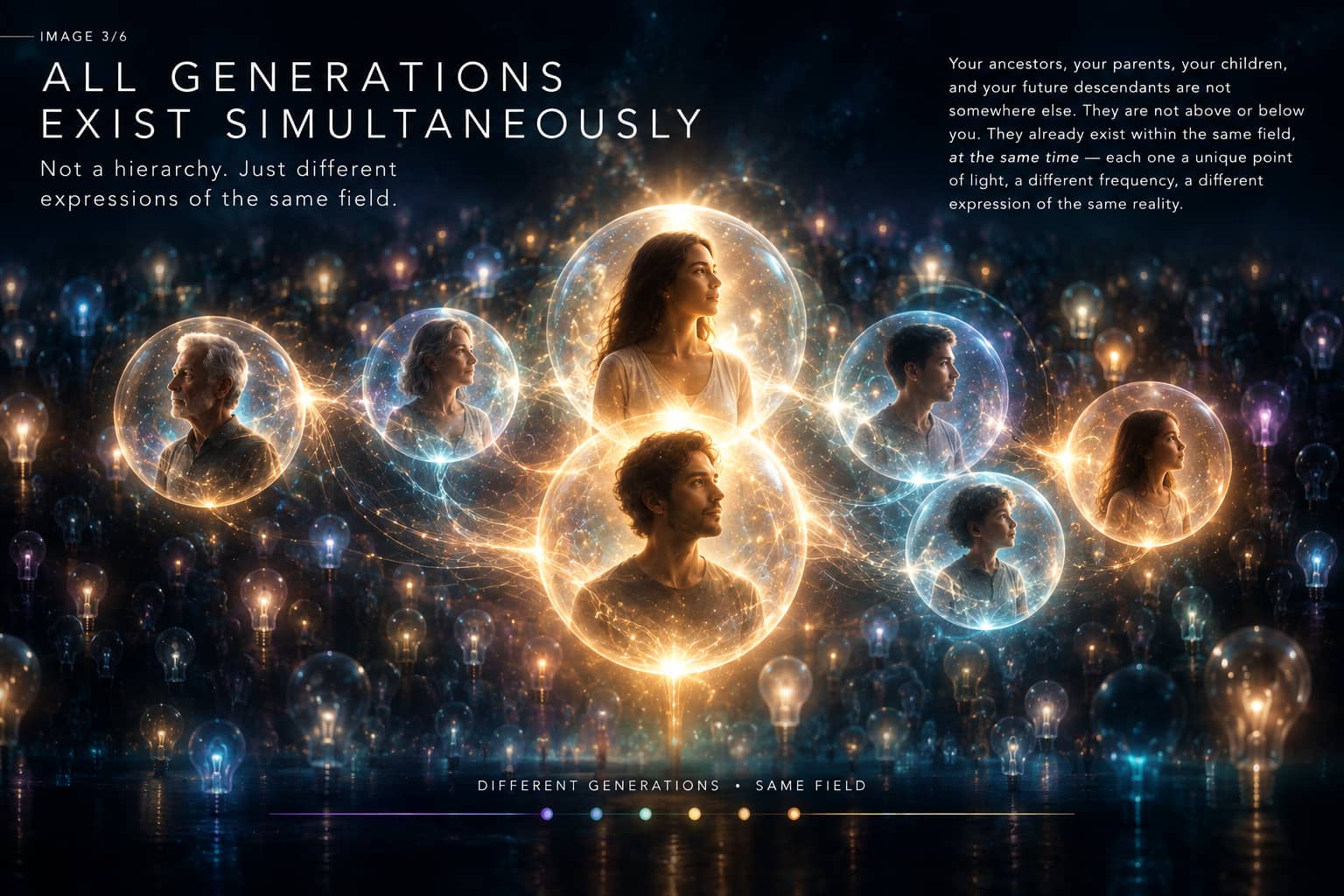
Think about what hierarchy actually requires. For one person to hold authority over another, one of them must have come first. The parent precedes the child. The teacher precedes the student. The founder precedes the employee. Hierarchy is built on the assumption that sequence is real. Someone was here before you. Therefore they know more, have more authority, and hold a higher position.
But if all time is now, as Einstein's own words suggest and as the block universe formalizes, then no one arrived before you. No one preceded you. The linear timeline that assigns your parents the role of "first" and you the role of "second" is a perceptual experience, not an objective fact.
Hierarchy is a program. It runs on the assumption that time is linear and sequential. Remove that assumption and the entire program loses its power.
This has immediate, practical consequences for how we think about inherited trauma.
The epigenetic research is real. Rachel Yehuda's work at Mount Sinai, published in World Psychiatry (2018), American Journal of Psychiatry (2014), and Biological Psychiatry (2015), demonstrates that trauma alters gene expression in ways that transmit to offspring. Holocaust survivors with PTSD showed altered cortisol levels and specific methylation changes in the FKBP5 gene. Their children, who never experienced the Holocaust directly, carried the same biological signatures. This was replicated in offspring of 9/11 survivors (Journal of Clinical Endocrinology & Metabolism, 2005). Inherited trauma is a measurable, biological phenomenon.
The conventional therapeutic approach is to process inherited trauma one program at a time. Identify the pattern, bring it to awareness, and work through it. This approach works. The neuroscience of metacognition confirms that awareness disrupts automaticity.
But what if there is a more efficient approach?
What if instead of removing inherited trauma line by line, you dissolve the program that made it inheritable in the first place?
That program is hierarchy. Inherited trauma flows downward through a chain of authority: parent to child, generation to generation. It requires a structure where one person's experience can be imposed on another through a power relationship. If hierarchy is not a truth but a program, and if you become aware of that program, then the entire architecture of transmission collapses. Not because the trauma was not real, but because the operating system that transmitted it was never real.
Remember the neuroscience: the moment you become aware of a program, you gain the power to change it. The basal ganglia runs the habit. The prefrontal cortex overrides it. Awareness is the mechanism. This holds at the level of individual brain programs. We propose that it holds at the level of reality's programs as well.
The Extreme Example: Pregnancy and Birth
If you have followed the argument this far, let's take it further.
Hierarchy tells us that parents create children. The physical process of pregnancy and birth is the most visible, tangible evidence for this claim. It is what makes hierarchy feel undeniable. Someone literally grew you inside their body. How could they not hold authority over you?
But consider the theory we have laid out. If all time is now, and if you have always existed as energy, then pregnancy did not create you. Pregnancy made you perceivable.
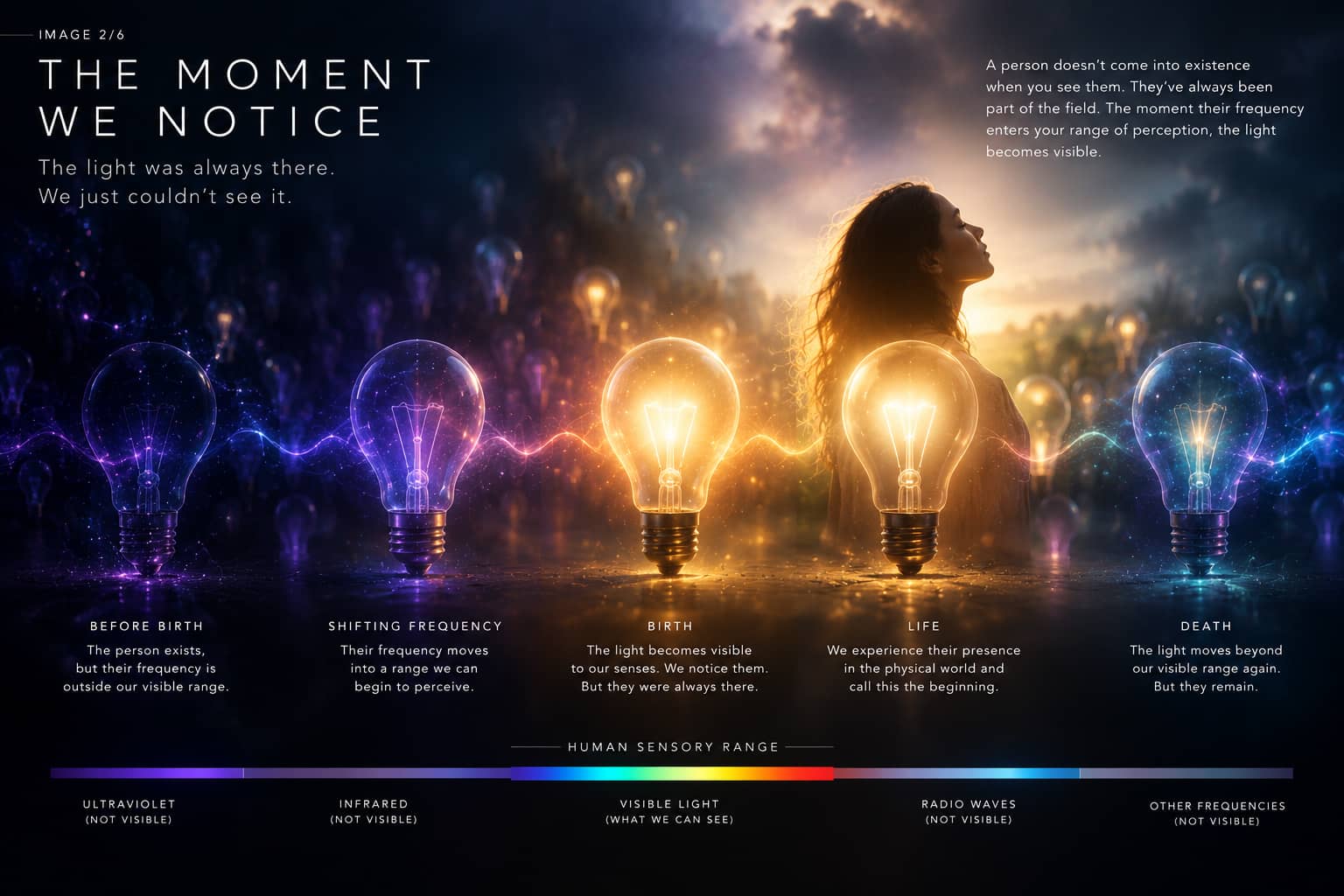
Frequency carries information. In a reality where 99.9999999% of everything that exists is energy your senses cannot detect, beings who have forgotten how to perceive beyond their five senses need a dramatic, physical event in order to register a new presence. Nine months of visible change. A body they can hold. A moment they can point to and say: "This is when you began."
But what if that moment is not when you began? What if it is when they became capable of noticing you?
As Dr. Joe Dispenza teaches: if you are not aware of something, it does not exist for you. The matrix did not create you through pregnancy. It created a sensory event dramatic enough for beings operating through physical senses alone to finally perceive your presence.
This reframe changes the parent-child relationship completely. Not by diminishing parenthood, but by questioning the story attached to it. If birth is revelation rather than creation, the parent did not make the child. The parent's body participated in a process that made the child perceivable. There is no ownership in that. No "I made you." No authority derived from having produced another being.
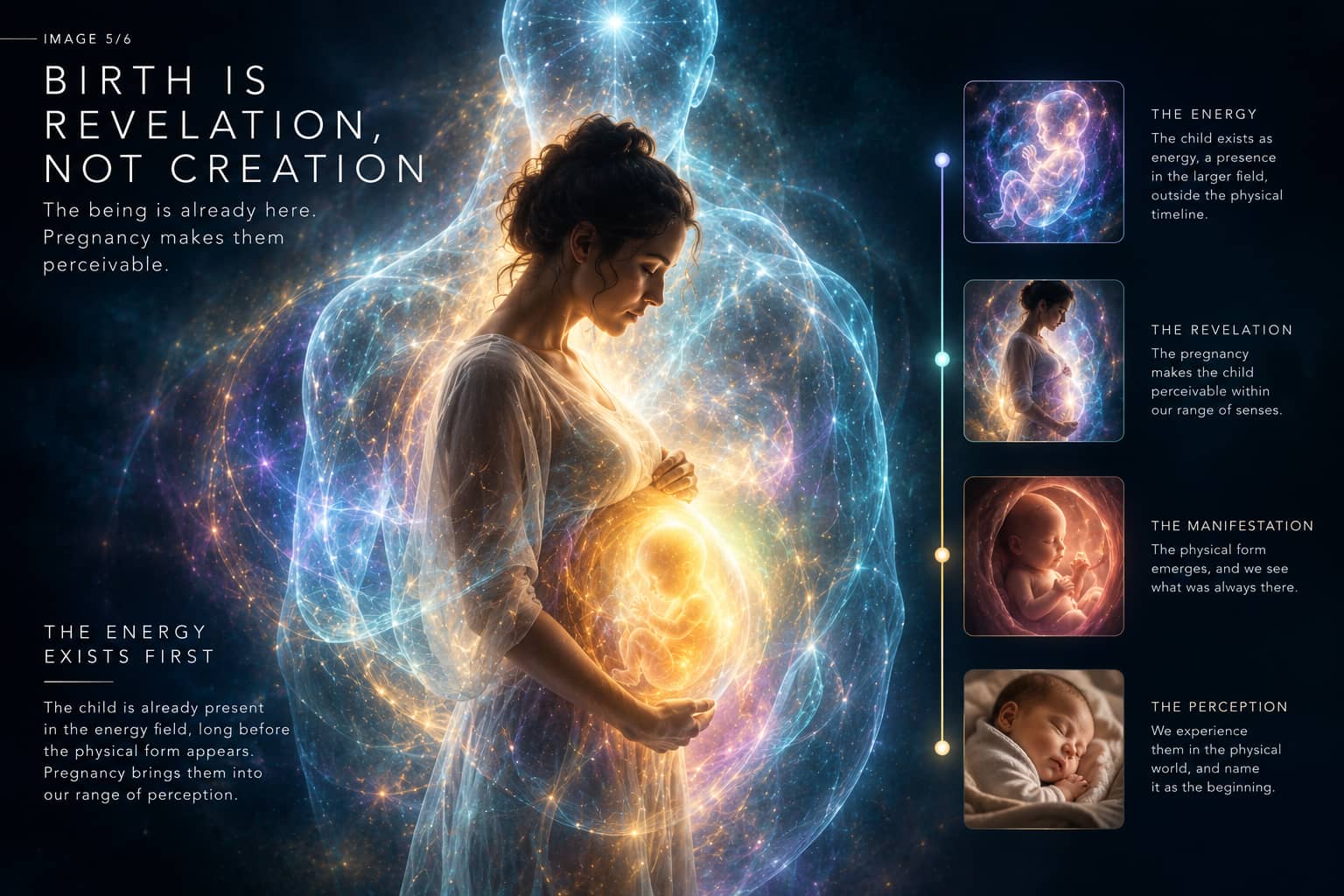
The hierarchy collapses. Not because you are rejecting your parents. But because the premise it stood on was never accurate.
And if birth is not creation but the beginning of perception, then what we call death is not destruction. It is the end of physical perceivability. The energy was here before the show began. It remains after the show ends.
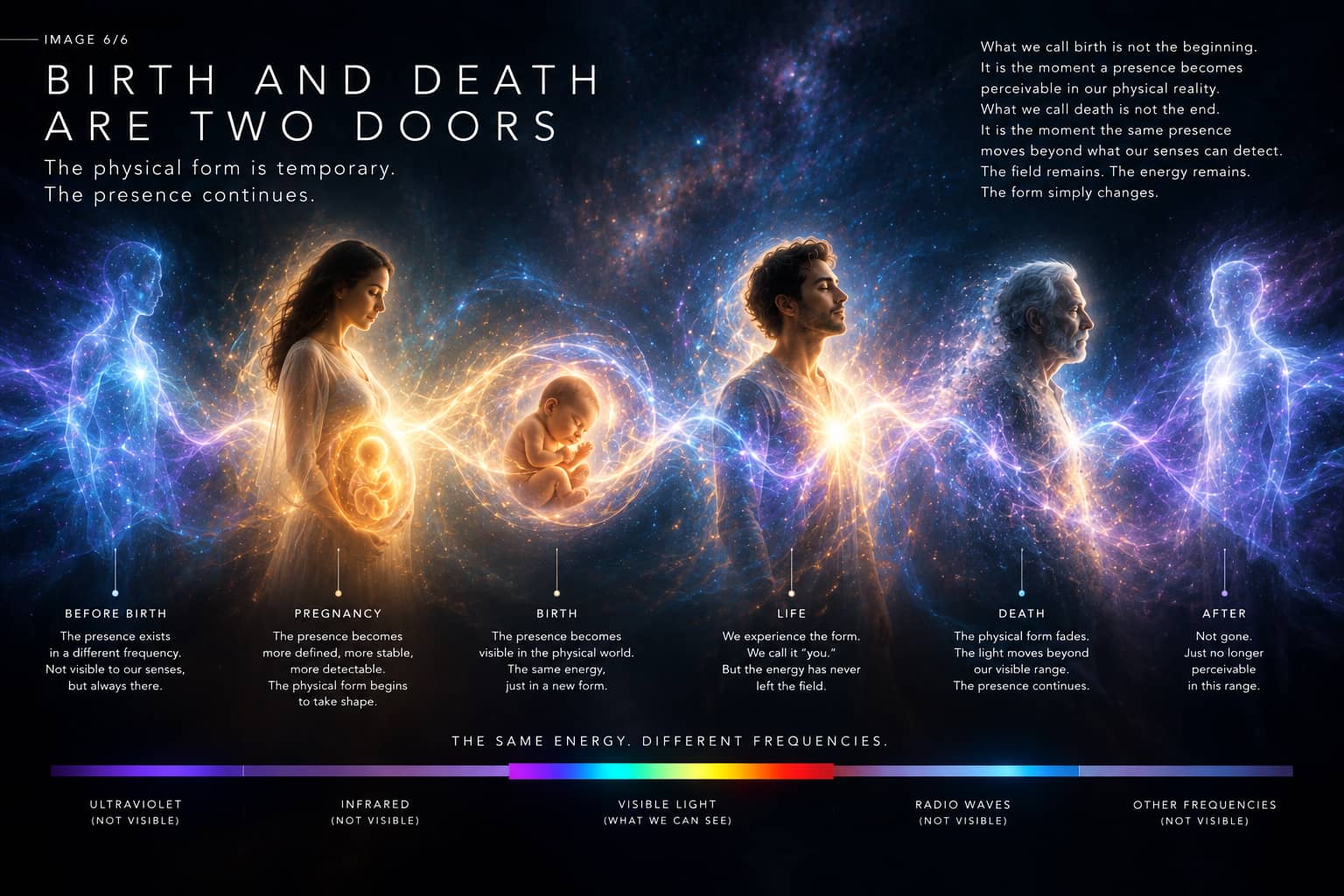
We are not diminishing the experience of parenthood. We are questioning whether the story we have attached to it is the full picture. And we are proposing that the story itself is a program, one that carries consequences for how authority, trauma, and identity flow between generations.
What Changes When You Uninstall the Program
If hierarchy is a program and you become aware of it, several things shift:
Inherited trauma loses its delivery mechanism. Trauma requires a power structure to flow through. Without hierarchy, there is no channel for one generation's pain to impose itself on the next. The trauma was real. The biological signatures are real. But the program that gave them authority over your present experience can be dissolved.
Authority returns to you. Every relationship built on "I was here first, so I know better" loses its automatic power. This does not mean you stop learning from others. It means you stop unconsciously submitting to a structure you never examined.
The healer-client hierarchy dissolves. In wellness and healing work, the practitioner is not above the client. Both are expressions of the same field. One holds a particular skill. Neither holds authority over the other. This is central to how Q-Vibe approaches its work.
You stop trying to heal what was never yours. If the inherited program ran because of hierarchy, and hierarchy is a program you can uninstall, then the most powerful healing work is not processing each inherited pattern individually. It is dissolving the operating system that installed them.
Observe the Program. Change the Program.
The neuroscience confirms it at the level of the brain. Awareness disrupts automaticity. See the program, and the program loses its hold.
The physics opens a door to a larger version of the same principle. Einstein saw time as an illusion. Planck showed that energy operates in ways the visible world does not predict. The observer effect demonstrates that measurement changes behavior at the quantum scale. Maybe, as Dispenza suggests, we are simply poor observers who have not yet looked carefully enough at the programs running our experience of reality.
This article is itself an act of observation. You have now seen a program that was designed to remain invisible. Hierarchy. The assumption that someone came before you, made you, and therefore holds authority over your experience.
Whether you accept this theory fully, partially, or simply find it interesting enough to consider, you have done the one thing the neuroscience says matters most.
You became aware of the program.
And awareness, at every scale science has been able to measure, is what changes everything.
Everything is inside of you. You do not really need anything outside of you. However, if you need some help, we are here.
Not Sure What Programs Are Running You?
Reading about unconscious programs is one thing. Identifying the specific ones running your life is another.
Quantum Emotional Mapping and Decoding (QEMD) is a remote session designed to locate the programs you cannot see on your own. The inherited patterns, the energetic walls, the belief systems installed so early that they feel like identity rather than programming. QEMD does not tell you what to believe. It maps what is already running and brings it into your awareness so you can decide whether to keep it.
Because as the neuroscience confirms: the moment you see the program, you gain the power to change it.
Book a free 15-minute Discovery Call to find out if a QEMD session is the right next step for you. No pressure. No sales pitch. Just a conversation about where you are and whether we can help.
Learn more about QEMD and book a session here.
And remember... Self Love is the Best Medicine.
References
Graybiel, A.M. (2008). "Habits, Rituals, and the Evaluative Brain." Annual Review of Neuroscience, 31, 359–387. annualreviews.org
Smith, A.C.W. et al. (2021). "Opposing roles for striatonigral and striatopallidal neurons in dorsolateral striatum in consolidating new instrumental actions." Nature Communications, 12, 5121. nature.com
Fleming, S.M. et al. (2010). "Relating Introspective Accuracy to Individual Differences in Brain Structure." Science, 329(5998), 1541–1543. science.org
"The Neurological Implications of Metacognition." (2026). Frontiers in Psychology. frontiersin.org
Bormashenko, E. (2022). "Fibonacci Sequences, Symmetry and Order in Biological Patterns, Their Sources, Information Origin and the Landauer Principle." Biophysica, 2(3). mdpi.com
Boman, B.M. et al. "Why Do Fibonacci Numbers Appear in Patterns of Growth in Nature?" The Fibonacci Quarterly, 55(5). fq.math.ca
Yehuda, R. & Lehrner, A. (2018). "Intergenerational transmission of trauma effects: putative role of epigenetic mechanisms." World Psychiatry, 17(3), 243–257. wiley.com
Yehuda, R. et al. (2014). "Influences of Maternal and Paternal PTSD on Epigenetic Regulation of the Glucocorticoid Receptor Gene in Holocaust Survivor Offspring." American Journal of Psychiatry. psychiatryonline.org
Yehuda, R. et al. (2015). "Holocaust Exposure Induced Intergenerational Effects on FKBP5 Methylation." Biological Psychiatry. biologicalpsychiatryjournal.com
Yehuda, R. et al. (2005). "Transgenerational effects of posttraumatic stress disorder in babies of mothers exposed to the World Trade Center attacks during pregnancy." Journal of Clinical Endocrinology & Metabolism, 90, 4115–4118.
Einstein, A. Letter to the Besso family, March 21, 1955. Einstein Archives 7-245. Authenticated in Isaacson, W. (2008), Einstein: His Life and Universe, and Calaprice, A. (2010), The Ultimate Quotable Einstein.
Ellis, G.F.R. (2006). "Physics in the Real Universe: Time and Spacetime." arXiv: gr-qc/0605049. arxiv.org
Ellis, G.F.R. & Rothman, T. (2010). "Time and Spacetime: The Crystallizing Block Universe." arXiv: 0912.0808. arxiv.org
Rutherford, E. (1911). "The Scattering of Alpha and Beta Particles by Matter and the Structure of the Atom." Philosophical Magazine, Series 6, 21(125), 669–688.
Einstein, A. (1905). "Does the Inertia of a Body Depend Upon Its Energy Content?" Annalen der Physik, 18, 639–641. https://guides.loc.gov/einstein-annus-mirabilis/1905-papers
Wikipedia: Observer effect (physics). en.wikipedia.org
Yin, H.H. & Knowlton, B.J. (2006). "The role of the basal ganglia in habit formation." Nature Reviews Neuroscience, 7, 464–476. nature.com