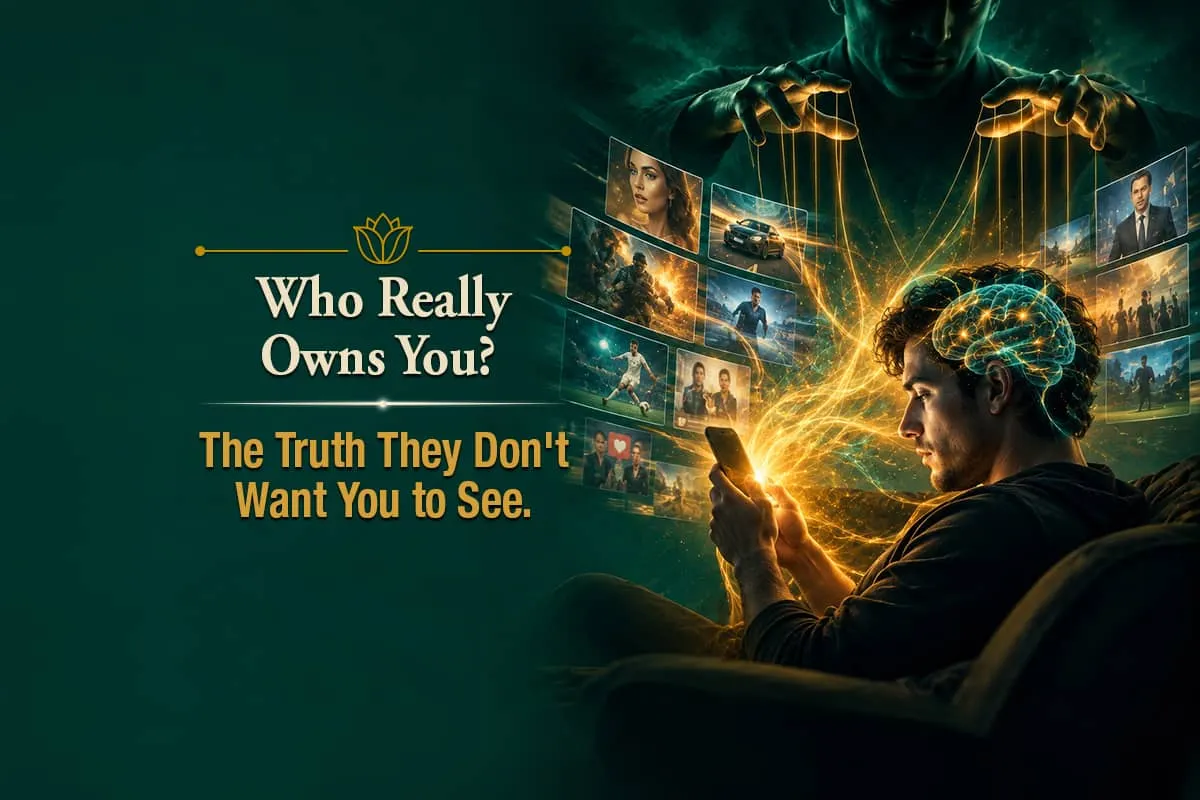
Who Really Owns You? The Truth They Don't Want You to See.
Every doom-scrolled headline, every prediction market number, every catastrophe you absorb without questioning is an instruction to your subconscious about what reality should look like.
I went to film school to learn how to hold your attention.
Now I'm here to tell you why you need to take it back.
I have an MFA in Film and Television Production from USC's School of Cinematic Arts. I spent years learning how to create tension visually so it feels dangerous before anyone says a word. How to cut between shots so your heart rate climbs without you noticing. How to use sound design, camera angles, and pacing to make you laugh, cry, or grip the armrest.
That was training. And it works. But here's the part they don't put on the syllabus: the audience's brain changes state the moment they sit down to watch. The critical mind dims. The feeling mind opens. And everything that comes through the screen has a direct path into the part of you that doesn't ask questions.
Every filmmaker knows this. Every advertiser knows this. Every algorithm knows this.
The question is: do you?
Your Brain Changes the Moment You Hit Play
Your brain runs on electricity. Tiny waves of energy that scientists can measure with a machine called an EEG. These waves change speed depending on what you're doing.
Beta waves (14 to 40 Hz) show up when you're thinking hard. Solving a math problem. Reading a book. Having a debate. Your critical mind is ON.
Alpha waves (8 to 13 Hz) show up when you relax. You're awake but not really analyzing anything. Your guard is down.
Theta waves (4 to 7.5 Hz) show up during deep meditation, light sleep, and hypnosis. This is the state where your subconscious mind is wide open.
In 1969, researcher Herbert Krugman hooked a test subject to an EEG and had her watch TV. Within 30 seconds, her brainwaves shifted from beta to alpha. When she picked up a magazine, her brain went right back to beta. Thirty seconds. That's all it took.
A 1984 study at the University of the Pacific expanded on this. Forty-eight people watched TV commercials while connected to EEGs. The result: significant increases in alpha waves during viewing (p < .01). And here's the kicker. The longer they watched, the deeper the alpha state got.
Multiple peer-reviewed studies since then have confirmed the pattern. Research in Media Psychology (2004) found that alpha activity during TV viewing correlated with reduced critical evaluation. A study in Nature Communications (2014) showed that brain engagement during television predicted real-world audience behavior at the population level.
Let that land for a second. You sit down. You watch. Your thinking brain dims. And within half a minute, you are in a state where information bypasses your judgment.
Not asleep. Not unconscious. Just... open.
The Scroll Makes It Worse
TV at least has an ending. Credits roll. The show is over.
Your phone has no ending. The scroll goes forever.
In 2025, a massive study published in Psychological Bulletin (Nguyen et al., Griffith University) analyzed 71 studies covering 98,299 people. They looked at what happens to your brain when you watch short-form videos on TikTok, Instagram Reels, YouTube Shorts, and similar platforms.
The more people scrolled, the worse their attention got. The worse their impulse control got. The harder it became to focus on anything complex. The relationship was dose-dependent. More scrolling, more damage.
The correlation with cognitive decline was moderate and consistent (r = -0.34). The strongest effects showed up in attention and inhibitory control.
The researchers explained it like this: fast-paced, high-stimulation content trains your brain to crave speed and novelty. After enough scrolling, your brain starts to struggle with slower, harder tasks. Reading. Problem-solving. Deep thinking. Not because you're lazy. Because your brain adapted to the environment you kept feeding it.
A separate review from the University of Bayreuth focused on young people and found that four or more hours a day of short-form video was associated with measurable increases in inattention, drops in working memory, and reduced self-regulation. A study in Computers in Human Behavior (Barr et al., 2015) found that heavier smartphone users scored lower on measures of analytical thinking. The researchers concluded that people offload cognitive effort to their devices, effectively using smartphones to supplant thinking.
The format itself is the weapon. Endless scrolling, rapid cuts, constant novelty. It isn't just delivering content. It is reshaping the organ that processes it.
They're Targeting the Animal in You
Now here's where it gets personal. Because I was trained to do this.
In film school, there's a saying that every filmmaker knows:
If a caveman likes your script, you have a hit.
That sounds like a joke. It's not. It's the formula.
Every piece of effective visual content, every ad, every news segment, every viral video, is engineered to trigger your most primitive instincts. Fear. Sex. Safety. Control. Power. These are the buttons that bypass your thinking and hit the oldest part of your brain directly.
Neuroscientist Joseph LeDoux discovered something remarkable about how the brain processes fear. A threatening stimulus reaches the amygdala, the brain's alarm system, in as little as 12 milliseconds. The prefrontal cortex, the part that actually thinks about what you're seeing, takes 250 to 300 milliseconds to process the same stimulus. The animal brain reacts twenty times faster than the thinking brain.
A 1998 study by Whalen et al. in The Journal of Neuroscience showed that the amygdala activates in response to fearful faces shown so quickly that subjects couldn't even consciously perceive them. Your survival brain processes threats you don't even know you saw.
LeDoux called this the "low road." Sensory input goes straight from the thalamus to the amygdala, skipping the cortex entirely. Your body reacts before your mind catches up. That's why you flinch at a jump scare before you realize it's fake. That's why a car commercial makes you feel powerful before you've read a single spec.
Robert Heath, Associate Professor of Advertising Theory at the University of Bath, demonstrated that the limbic system processes emotional content in advertising regardless of whether the viewer is paying attention. His research showed that ad recall doesn't correlate with ad effectiveness. You don't have to remember the ad for it to change your behavior. The emotional content lodges in the subconscious whether you noticed it or not.
Now put these two facts together.
Fact one: within 30 seconds of watching, your critical mind dims and you enter a programmable brainwave state.
Fact two: the content playing during that window is specifically designed to trigger your survival instincts, which fire 20 times faster than your ability to think about them.
The gatekeeper is asleep. The animal is wide awake. And the content is built to speak directly to the animal.
That's not entertainment. That's engineering.
These Are the Same States Used in Hypnosis
If this sounds like programming, that's because the science says it is.
A study in PLOS ONE (Keshmiri et al., 2020) measured brainwave variability in people with different levels of hypnotic suggestibility. The finding: people who are more suggestible show a specific neural signature in the theta, alpha, and beta bands. The exact same bands that passive viewing activates.
Research in the International Journal of Clinical and Experimental Hypnosis (Williams and Gruzelier, 2001) found that alpha doesn't just index relaxation. It indexes the hypnotic experience itself. People with high hypnotic susceptibility showed more alpha power during hypnosis. Alpha is the doorway to the programmable mind.
A study in the American Journal of Clinical Hypnosis (Brady and Stevens, 2000) went further. They boosted participants' theta activity using audio stimulation. What happened? People who started with low suggestibility became significantly more suggestible. Increasing theta literally made people more programmable.
And a peer-reviewed study in Psychophysiology (Terhune et al., 2011) found that highly suggestible people showed disrupted communication in the frontal-parietal network during hypnosis. That's the network responsible for executive function. For critical thinking. For saying "wait, something doesn't add up here."
The state your screen puts you in is the same state a hypnotherapist uses to install new beliefs. The only difference? The hypnotherapist tells you what they're doing.
Now Scale It to Millions
One person watching shifts their own brainwaves. But when twenty million people watch the same show, in the same programmable state, absorbing the same images and outcomes... something bigger happens.
The Global Consciousness Project (GCP), launched at Princeton University in 1998, runs a network of about 65 random number generators across the globe. Normally, their output is statistically flat. Random noise. But during events that focus massive collective attention, like the September 11 attacks, the data shows small but consistent deviations from randomness.
Over 17 years and more than 500 pre-registered tests, the cumulative departure reached 7 sigma. That means the probability of the pattern being pure chance is roughly 1 in a trillion. Independent critics, including Jeffrey Scargle at NASA Ames, have raised valid methodological concerns. Effect sizes are small. Event selection invites bias. But the signal has persisted for two decades without collapsing.
The Princeton Engineering Anomalies Research (PEAR) lab ran controlled experiments for 12 years showing that ordinary people could influence random number generators through focused intention. The results were tiny but statistically significant, roughly 50.01 to 49.99 per trial, consistently in the intended direction across millions of trials.
Self-fulfilling prophecy research supports this from a different angle. A peer-reviewed study in PLOS ONE (Petropoulos Petalas et al., 2017) showed that adopting a belief about economic conditions shifted real decision-making to match the prediction. Robert Merton formalized this idea in the 1940s: a false definition of a situation can evoke behavior that makes it real.
Now apply all of this to The Simpsons.
People say The Simpsons "predicted" events. But what if millions of viewers absorbed those storylines in an alpha state, planted those images in their collective subconscious, and the sheer weight of that shared visualization shifted the probability? Not prediction. Participation.
The same logic applies to news cycles. To political forecasts. To prediction markets like Polymarket. They don't just forecast outcomes. They broadcast them into millions of receptive, programmable minds. Every headline consumed without questioning is a vote for that version of reality.
Your attention is not neutral. It is a creative force. And right now, the algorithm is deciding where it goes.
What We Know vs. What We Interpret
Everything above is grounded in published, peer-reviewed research.
The brainwave shift during passive viewing is documented (Krugman 1971, UPacific 1984, multiple EEG studies). The cognitive decline from scrolling is backed by a 98,000-participant meta-analysis. The amygdala's shortcut past the thinking brain is established neuroscience (LeDoux 1996, Whalen 1998). The hypnosis-suggestibility link with alpha and theta is replicated. The Global Consciousness Project data is real, with legitimate debate about interpretation. The self-fulfilling prophecy is one of the most replicated findings in social science.
The interpretation, that millions of people absorbing the same content in a programmable state collectively shift the probability of those outcomes becoming real, goes further than any single study claims. That's the Q-Vibe framework connecting research across neuroscience, consciousness studies, and behavioral science into a bigger picture: observation is not passive. Consciousness participates in what becomes real. And the brainwave state you're in when you observe determines whether you're thinking about what you see or being shaped by it.
You don't have to accept the full framework to act on the science. Even the most conservative reading says the same thing: what enters your mind while your guard is down is not just entertainment. It's programming.
So, What Do You Do?
You take back control of the window.
Know when you're in alpha. If you've been watching a screen for more than two minutes without actively thinking, solving, or creating, you're probably there. You're not analyzing. You're absorbing.
Recognize the primal triggers. Fear. Sex. Power. Safety. If the content is pulling those levers, it's not informing you. It's programming you. A filmmaker designed it that way on purpose.
Break the scroll. The Griffith University research showed the damage is dose-dependent. More scrolling, more cognitive decline. Set the phone down. Pick up a book. Go outside. That resets your brainwaves toward beta, where your critical mind comes back online.
Stop feeding outcomes you don't want to experience. Every doom-scrolled headline, every prediction market number, every catastrophe you absorb without questioning is an instruction to your subconscious about what reality should look like. If you don't want that future, stop watching it on repeat.
Choose your own programming. Alpha and theta aren't the enemy. Meditation uses the same states to install the reality you choose. The brainwave window is not the problem. The question is who's filling it: the algorithm or you.
Remember the collective. You're not an isolated viewer. You're part of a network of observers. Your attention is a vote for a particular version of reality. Every time you watch something, you're contributing to whether that thing becomes more real. Spend your attention like it matters. Because it does.
And we haven't even talked about what's entering through your ears yet. That's the next conversation.
Start With What's Already Inside You
Before you reach for any tool, any program, any product, remember: everything you need is already inside you. The research above simply explains why protecting that internal environment matters so much.
When you're ready to explore how your personal frequency field has been shaped by the programming you've absorbed, and how to reset it, we're here.
Book a Discovery Call at: qvibewellness.com/discoverycall to learn how our Remote Sessions, QEMD (Quantum Emotional Mapping and Decoding), QCA (Quantum Clarity And Alignment) and CRVS (Comprehensive Remote Visera Scan) can help you identify and release the patterns running beneath your awareness.
Q-Vibe frequency-infused products, including copper water bottles, quantum patches, crystal quartz grids, and frequency-infused bracelets and jewelry, are designed to support your field throughout the day. Not as a replacement for the inner work, but as a companion to it.
Explore Q-Vibe Products at qvibewellness.com
And remember... Self Love is the Best Medicine.
References
Krugman, H. E. (1971). Brain wave measures of media involvement. Journal of Advertising Research, 11(1), 3-9.
University of the Pacific (1984). The effect of television viewing on college students: An EEG analysis of cerebral asymmetry. Master's thesis.
Smith, M. E. & Gevins, A. (2004). Attention and brain activity while watching television: Components of viewer engagement. Media Psychology, 6(3), 285-305.
Dmochowski, J. P. et al. (2014). Audience preferences are predicted by temporal reliability of neural processing. Nature Communications, 5, 4567.
Nguyen, L. et al. (2025). Feeds, feelings, and focus: A systematic review and meta-analysis examining the cognitive and mental health correlates of short-form video use. Psychological Bulletin, 151(9), 1125-1146. doi:10.1037/bul0000498
Ebster, M. et al. (2025). Taming the endless scroll? Short-form videos, digital routines and neurocognitive outcomes in youth: A systematic literature review. University of Bayreuth.
Barr, N. et al. (2015). The brain in your pocket: Evidence that smartphones are used to supplant thinking. Computers in Human Behavior, 48, 473-480.
LeDoux, J. E. (1996). The Emotional Brain: The Mysterious Underpinnings of Emotional Life. Simon & Schuster.
Whalen, P. J. et al. (1998). Masked presentations of emotional facial expressions modulate amygdala activity without explicit knowledge. The Journal of Neuroscience, 18(1), 411-418.
Luo, Q. et al. (2010). The neural substrate of amygdala automaticity in emotion processing. NeuroImage, 47, S143.
Heath, R. G. (2006). Emotional content in advertising has hardly any influence on brand favourability. University of Bath.
Lindstrom, M. (2008). Buyology: Truth and Lies About Why We Buy. Doubleday.
Keshmiri, S. et al. (2020). Higher hypnotic suggestibility is associated with the lower EEG signal variability in theta, alpha, and beta frequency bands. PLOS ONE, 15(4), e0230853. doi:10.1371/journal.pone.0230853
Williams, J. & Gruzelier, J. (2001). Differentiation of hypnosis and relaxation by analysis of narrow band theta and alpha frequencies. International Journal of Clinical and Experimental Hypnosis, 49(3), 185-206.
Brady, B. & Stevens, L. (2000). Binaural-beat induced theta EEG activity and hypnotic susceptibility. American Journal of Clinical Hypnosis, 43(1), 53-69.
Terhune, D. B., Cardena, E., & Lindgren, M. (2011). Differential frontal-parietal phase synchrony during hypnosis as a function of hypnotic suggestibility. Psychophysiology, 48(10), 1444-1447.
Nelson, R. D. (2001). Correlation of continuous random data with major world events. Foundations of Physics Letters, 14(6), 497-510.
Nelson, R. D. & Bancel, P. A. (2011). Effects of mass consciousness: Changes in random data during global events. Explore, 7(6), 373-383.
Jahn, R. G. & Dunne, B. J. (2005). The PEAR proposition. Journal of Scientific Exploration, 19(2), 195-245.
Petropoulos Petalas, D., van Schie, H., & Hendriks Vettehen, P. (2017). Forecasted economic change and the self-fulfilling prophecy in economic decision-making. PLOS ONE, 12(3), e0174353. doi:10.1371/journal.pone.0174353.
Merton, R. K. (1948). The self-fulfilling prophecy. The Antioch Review, 8(2), 193-210.