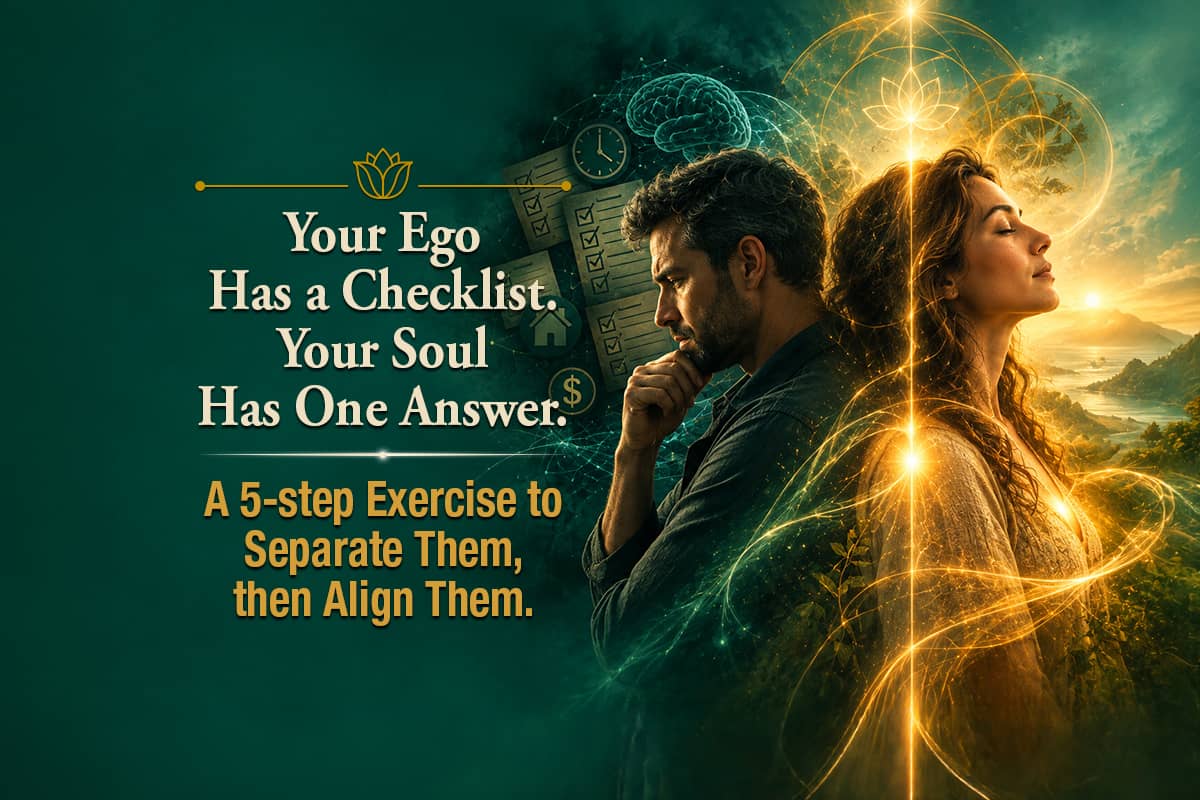
Your Ego Has a Checklist. Your Soul Has One Answer.
A 5-step exercise to separate them, align them, stop the war and build a powerhouse of unlimited possibilities.
I Stood in Front of a Decision that Made No Logical Sense
My mind had built the perfect checklist. Years of experience, pattern recognition, and "knowing better" had produced a clear set of criteria for what the right choice should look like. I held that checklist up to the option in front of me. It checked one box. One. Out of everything my rational mind said mattered, a single criterion was met.
And yet something deeper kept saying yes.
Not loudly. Not with evidence. Not with a pitch deck of reasons. Just a steady pull that would not stop.
What followed was one of the most intense internal battles I have experienced. Logic on one side, knowing on the other. Weeks of going back and forth. And the harder I tried to think my way to the answer, the louder both voices became. Until I did the one thing that changed everything.
I stopped arguing with myself. I sat in stillness. And I asked a question I had never thought to ask before:
Who is giving me this answer?
That single question cracked the whole thing open.
Two Voices, One Decision
Here is what I discovered. Every decision I had ever made was actually two decisions running at the same time. Two separate intelligences inside me were answering the same question, and I had been treating their answers as one voice. No wonder I felt torn. I was listening to a conversation between two beings with completely different priorities.
The ego answered with conditions. It ran comparisons. It measured risk. It consulted the opinions of people who would never have to live with the outcome. It asked: Does this look right? Does this make sense? Will people approve? Is this safe?
The soul answered with knowing. No conditions. No justification. No spreadsheet. Just a clean signal. Expansion. Quiet certainty. And when I asked why, it had no argument to offer. It simply repeated the answer.
The problem was not that the ego was wrong. The ego is powerful. But the ego's checklist was not built only from personal experience. That checklist started forming long before you were old enough to question it.
From conception through puberty, you absorbed programming from the two people you interacted with first: your parents. Their fears became your fears. Their definitions of safety, success, and worthiness became the invisible criteria on your checklist. On top of that, society layered its own expectations. Culture, religion, school systems, and social norms all added items to the list, telling you what "enough" looks like and what earns love. You did not choose those filters. You inherited them. And beneath all of the specific conditions your ego runs, two primary fears drive every single one.
The fear that you are not enough.
And the fear that you will not be loved.
Those two fears are the seed cause. Every item on the ego's checklist traces back to one of them. "Does this look right?" is the fear of not being enough. "Will people approve?" is the fear of not being loved. The ego built its entire operating system on the foundation of a child trying to earn approval from the first two people who mattered.
And it goes deeper than one generation. Epigenetic research has shown that stress responses and emotional patterns pass through ancestral DNA. The fears you carry may not even be yours. They may belong to your parents, your grandparents, or further back. Mark Wolynn documents this in It Didn't Start with You, tracing how unexplained anxiety, self-sabotage, and chronic patterns often originate not in personal experience but in the unresolved trauma of previous generations. Layers of human consciousness programming, written into your biology before you took your first breath.
None of this makes the ego your enemy. It makes the ego a child running very old software. And you cannot hear the soul's answer when that software is louder. For decades, I had been trained to trust the louder voice.
Your Brain Was Built to Favor the Checklist
This is not just a spiritual observation. Neuroscience confirms it.
In a landmark 1997 study published in Science, entitled Deciding Advantageously Before Knowing the Advantageous Strategy, researchers Antonio Damasio and Antoine Bechara tested how people make decisions under uncertainty. Participants chose cards from four decks without knowing that two decks were rigged to lose. Something remarkable happened. Their bodies began generating stress responses when reaching for the bad decks before their conscious minds figured out which decks were dangerous. The body knew. The rational mind had not caught up yet.
The researchers called this the somatic marker hypothesis. Your body stores the wisdom of past experience as physical signals: gut feelings, chest tightness, a sense of expansion or contraction. These signals often arrive faster and more accurately than logical analysis. But most people override them because the signals carry no explanation. The ego demands reasons. The body just knows.
A second finding makes this even more practical, a 2007 study entitled Putting feelings into words: affect labeling disrupts amygdala activity in response to affective stimuli by psychologist Matthew Lieberman and his team at UCLA found that simply naming an emotion reduces its grip on you. When participants put feelings into words, their amygdala activity dropped. The conscious act of labeling what you feel changes how your brain processes it.
This is exactly what happened to me when I asked "who is giving me this answer?" I was not silencing either voice. I was labeling them. And the moment I labeled the ego as the ego, its volume dropped. The soul's signal became clear.
Telling the Voices Apart
Once I started practicing this, patterns emerged. The ego and the soul answer differently. They feel different in the body. They carry different energy.
The ego's answer sounds like this:
"Yes, but only if..." It comes with conditions, timelines, and exit strategies. It references what other people will think. It pulls from past failures and projects them forward. It rushes you toward a decision so you stop feeling the discomfort of uncertainty. And it disguises itself as wisdom by calling itself "practical" or "realistic."
The soul's answer sounds like this:
It does not argue. It does not list reasons. It delivers a single clean signal and waits. You can ignore it for days, weeks, or months, and when you come back, the answer has not changed. It carries a feeling of expansion. There is peace in it even when the choice it points to feels terrifying to the mind.
Dr. Joe Dispenza teaches that the body becomes addicted to familiar emotional states. Your nervous system builds a chemical dependency on the feelings associated with your habitual patterns of thinking. When the soul offers a direction that breaks those patterns, the body panics. Not because the choice is wrong. Because it is unfamiliar. The ego then translates that panic into logic: "This does not check enough boxes."
And you believe it. Because it sounds reasonable.
Power vs. Force: Why the Soul Always Wins
David Hawkins drew a line that clarified this for me permanently.
In his book Power vs. Force, Hawkins distinguished between two fundamentally different energies. Force is limited. It requires constant effort. It pushes against resistance and eventually exhausts itself. It wins battles but loses the longer game. Power is different. Power is self-sustaining. It does not need to push because it generates its own momentum. It does not need to convince because its truth is self-evident over time.
The ego operates through force. Every ego-driven decision requires maintenance. You have to keep justifying it. You have to keep managing the doubt. You have to keep proving that the checklist was right.
The soul operates through power. A soul-aligned decision generates its own energy. It does not need defending. Confirmation arrives not because you manufactured it, but because alignment creates its own momentum.
Ask yourself about the decisions in your life that turned out to be right. Not the safe ones. The ones that actually changed your trajectory. How many of them checked every box on your ego's list? And how many of them terrified you before they transformed you?
Exercise: The Soul vs. Ego Decision Filter
I developed this practice out of that experience, and I use it every time I face a choice that matters. It works by stripping away the layers the ego adds to every decision until only the soul's signal remains.
Three questions. Answer each one honestly. Write your answers by hand, not on a screen. (If you want to go deeper, use your non-dominant hand. It bypasses the thinking mind and opens a more direct line to the subconscious.)
Question 1: Strip the judgment.
If nobody ever knew about this choice. If no one could approve or disapprove. If the opinions of every person in your life were removed from the equation. What would your answer be?
Question 2: Strip the outcome.
If this choice could not fail and could not succeed. If there were no consequences and no reward. If you removed the entire concept of results. What would you choose?
Question 3: Strip the identity.
If nothing about this choice could define you. If it said nothing about who you are, what you are worth, or where you belong. If you made this decision purely for the experience of it, with nothing to prove. What does your soul actually want?
Now compare those three answers to the answer your ego gave you.
If they match, move forward with confidence.
If they do not match, you just found the gap between force and power. And that gap is where most people stay stuck for years, sometimes for an entire lifetime, making the ego's choice over and over and calling it "being smart."
The Goal Is Not to Kill the Ego
Here is where most spiritual teachings stop too early. They tell you the ego is the enemy. Silence it. Transcend it. Override it.
That is a mistake.
The ego is powerful. It is not going anywhere. As long as you are human, you carry an ego. And that ego has kept you alive, kept you learning, kept you building. The problem was never that you have an ego. The problem is that the ego and the soul were pulling in opposite directions.
When the ego fights the soul, you get paralysis, self-sabotage, and the kind of exhaustion that no amount of sleep can fix. But when the ego and the soul align on the same direction, you create a powerhouse. The soul provides the compass. The ego provides the engine. Together they are unstoppable.
So the real question is not "how do I silence my ego?" The real question is: how do I get these two on the same team?
Exercise: The Alignment Reframe
Once the 3-question filter reveals the soul's answer, most people hit a wall. The soul says go. The ego says no. And the standoff begins again.
The ego resists the soul's answer because it associates that direction with pain. Risk, judgment, the unknown. You do not overcome that resistance by arguing with it. You overcome it by changing the association. Show the ego a new map. Write your answers by hand, not on a screen. (Again, your non-dominant hand will pull a more honest answer. Let the subconscious respond before the ego edits it.)
Step 1: Show the ego the cost of its own answer.
Ask yourself: If I follow the ego's choice for the next five years, where does this path actually end? What do I lose by staying safe? What does "playing it smart" cost me in time, growth, and aliveness?
The ego fears the soul's direction. But it has never honestly calculated the price of its own.
Step 2: Show the ego what it gains from the soul's answer.
Ask yourself: If the soul's answer works, does the ego still get what it needs? Safety, growth, respect, stability. Does it eventually get all of those, just through a different door?
In almost every case, the answer is yes. The ego is not wrong for wanting security. It is just looking at an outdated map. When you show it a route that includes the soul's destination and still delivers what it values, the resistance drops. Not because you defeated the ego. Because you included it.
That is alignment. That is when force becomes power.
Your Soul Knows Best
I will tell you what I learned from the choice that started all of this.
The hardest part was not hearing the soul's answer. The soul had been answering from the beginning. The hardest part was accepting that my ego's checklist, the one I spent years building, the one I trusted as proof that I had grown and learned, was the very thing standing between me and what I actually wanted.
Michael Singer documented this exact surrender in The Surrender Experiment. His entire life became the evidence. Every time he stopped overriding the flow of life with his mental preferences and let the soul lead, the result was bigger than anything his ego could have engineered. Not once. Over and over, for decades. His ego never would have chosen the path that built his life. His soul did, and the ego eventually saw the proof.
The ego builds checklists because checklists create the illusion of control and safety. But life does not ask you to control it. Life asks you to listen to it. The soul has never given you a wrong answer.
It has only given you answers you were not ready to hear.
Get them on the same team. And watch what happens.
Ready to find out which voice has been running your decisions?
Q-Vibe's QEMD (Quantum Emotional Mapping and Decoding) sessions are designed to map the specific energetic walls your ego has built and bring them into conscious awareness.
The work starts with one question: who has been answering for you? Book a Discovery Call or Learn About QEMD.
And remember... Self Love is the Best Medicine.
References
Bechara, A., Damasio, H., Tranel, D., & Damasio, A. R. (1997). Deciding Advantageously Before Knowing the Advantageous Strategy. Science, 275(5304), 1293–1295.
Lieberman, M. D., Eisenberger, N. I., Crockett, M. J., Tom, S. M., Pfeifer, J. H., & Way, B. M. (2007). Putting Feelings Into Words: Affect Labeling Disrupts Amygdala Activity in Response to Affective Stimuli. Psychological Science, 18(5), 421–428.
Hawkins, D. R. (2002). Power vs. Force: The Hidden Determinants of Human Behavior. Hay House.
Dispenza, J. (2012). Breaking the Habit of Being Yourself: How to Lose Your Mind and Create a New One. Hay House.
Singer, M. A. (2015). The Surrender Experiment: My Journey into Life's Perfection. Harmony Books.
Wolynn, M. (2016). It Didn't Start with You: How Inherited Family Trauma Shapes Who We Are and How to End the Cycle. Viking.