
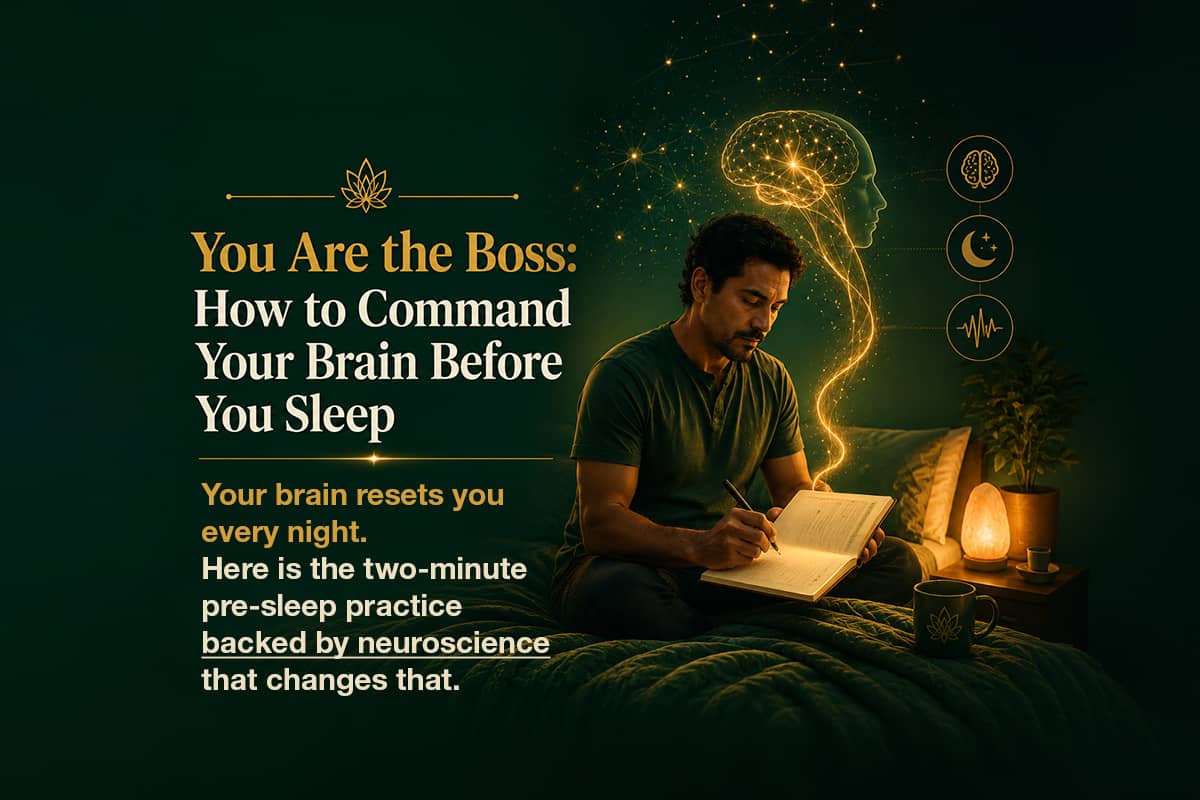
You Are the Boss: How to Command Your Brain Before You Sleep
Your brain resets you every night because no one gave it a new instruction. Here is the two-minute pre-sleep practice backed by neuroscience that changes that.
If you read Part 1 of this series, you know the problem. While you sleep, your brain runs its maintenance cycle. It consolidates what is most dominant, not what is most recent. It reinforces the old program because the old program has the most repetition behind it. And you wake up reset, right back to the emotional baseline the subconscious has decided is safe.
But here is what most people never consider. You do not have to hand the night over passively. Your brain is not running the reset against your will. It is following the most consistent instruction it has ever received. And you are the only one authorized to change that instruction.
The question is not whether your brain will listen. It will. The question is whether you will speak to it before you close your eyes.
What the Science Actually Shows
Research on prospective memory consolidation, published in Sleep to Implement an Intention in PMC, confirms that intentions held actively at the edge of sleep receive preferential treatment during slow-wave memory consolidation. The brain does not treat all information equally overnight. It prioritizes what has been flagged as relevant and forward-facing. A clear intention carried into sleep is processed differently than a passive thought.
Emotion also appears to play a role in what the sleeping brain holds onto, though the picture is more nuanced than it is often made out to be. A 2019 meta-analysis in Frontiers in Psychology examined whether sleep preferentially strengthens emotional memories over neutral ones. Its overall finding was cautious: across the full body of studies, sleep did not reliably favor emotional over neutral material. The effect only appeared under certain conditions, such as when memory was tested by free recall rather than simple recognition. In other words, the science here is still being worked out, and any honest account has to hold it loosely. What the broader literature does suggest, and what this practice leans on, is a gentler and better-supported idea: the brain tends to prioritize what carries genuine personal relevance and emotional weight. That is why the old subconscious program is so persistent. It is not just practiced. It is emotionally loaded with years of fear, self-doubt, and survival urgency. And it is why the new instruction you carry into sleep is worth genuinely feeling, not just writing.
But this same mechanism works in your favor. If you bring the new version of yourself to sleep wrapped in genuine emotion, in love, in joy, in felt gratitude, the brain now has competing material with emotional weight behind it. That changes what gets consolidated.
Writing the intention before sleep deepens this further. Research from UCLA on affect labeling shows that putting feelings into words calms the amygdala and reduces the emotional noise that interferes with clean memory consolidation. Writing before sleep pre-organizes what the brain will process overnight. Instead of a pile of unsorted information, you hand it a clear instruction: this is what matters. This is what I want to keep.
The brain does not default to the old program out of stubbornness. It defaults because it is the most practiced instruction available. Tonight you give it a new one.
The Practice: Your Pre-Sleep Command
This does not require an app, a device, or a complicated ritual. It requires a piece of paper, a pen, and two to five minutes of genuine presence before you close your eyes.
Sit quietly. Breathe slowly. Bring to mind the most significant shift you experienced today, a moment you felt different, a thought that opened something, a feeling you want to carry forward. It does not have to be dramatic. The brain measures significance by emotional charge, not size.
Now write directly to your brain. Not as a diary entry. As a command given with love:
Dear Brain,
With all the love, joy, and compassion in my heart, I command you tonight to keep the new version of me. The version that felt ____________ today. The version that knows ____________. The version that is becoming ____________.
As you go through your integration process tonight, I command you to discard what no longer serves this new version of me. The old programs and patterns of ____________ have kept me safe. I honor what it was trying to do. I am releasing it now. It is no longer needed.
The new me is safe. The new me is still alive. The new me is who you are here to protect now.
Thank you. I love you.
Fill in the blanks with what is true for you today. Write what is real. The brain responds to truth, not performance. When you finish, read it back slowly and let yourself feel the words. That emotional charge is the signal the sleeping brain needs to prioritize your new instruction over the old one.
Why You Thank the Old Program Before Releasing It
The subconscious does not respond well to rejection. When you try to force out the old program with frustration or shame, you activate the same threat detection system that created the resistance in the first place. The amygdala reads aggression toward the self as danger and the old program digs in deeper.
Approaching the release with genuine gratitude, acknowledging that the old pattern was doing its best to keep you alive, tells the nervous system it is safe to let go. This is not sentimentality. It is neurological precision. Love and compassion directed at the old version of yourself is the most efficient way to make space for the new one.
Consistency Is What Rewires the Brain
One night will not undo thirty years of grooved wiring. But one night is a data point. Every night you do this, you are giving the sleeping brain a new instruction with emotional weight behind it. Over time that instruction begins to compete with the old program. The Groundhog Day morning reset becomes less severe, then less frequent, then one day it simply is not there.
This is the nightly practice. It runs alongside and supports the deeper work of finding and releasing what is actually driving the pattern at its seed cause. The deeper sessions find the seed. This practice waters the new growth every single night so it has the best possible conditions to take hold.
Everything you need is already inside you. Sometimes it just takes speaking to yourself like you mean it.
If the reset is still running deep despite consistent practice, something older may be driving it. Explore our remote sessions at https://qvibewellness.com/quantum-wellness-remote-services to go deeper.
And remember... Self Love is the Best Medicine.
References
Diekelmann, S., Wilhelm, I., Wagner, U., & Born, J. (2013). Sleep to implement an intention. Sleep, 36(1), 149-153. https://pmc.ncbi.nlm.nih.gov/articles/PMC3524538/
Scullin, M.K. & McDaniel, M.A. (2016). Consolidation of prospective memory: Effects of sleep on completed and reinstated intentions. Frontiers in Psychology. https://www.frontiersin.org/journals/psychology/articles/10.3389/fpsyg.2016.02025/full
Carbone, J., & Diekelmann, S. (2024). An update on recent advances in targeted memory reactivation during sleep. npj Science of Learning, 9(1), 31. https://www.ncbi.nlm.nih.gov/pmc/articles/PMC11018807/
Lipinska, G. et al. (2019). Preferential consolidation of emotional memory during sleep: A meta-analysis. Frontiers in Psychology. https://www.frontiersin.org/journals/psychology/articles/10.3389/fpsyg.2019.01014/epub
Stickgold, R. & Walker, M.P. (2021). Memory and sleep. PMC: https://pmc.ncbi.nlm.nih.gov/articles/PMC7983127/
Lieberman, M.D., Eisenberger, N.I., Crockett, M.J., Tom, S.M., Pfeifer, J.H., & Way, B.M. (2007). Putting feelings into words: Affect labeling disrupts amygdala activity in response to affective stimuli. Psychological Science, 18(5), 421-428. https://journals.sagepub.com/doi/10.1111/j.1467-9280.2007.01916.x